
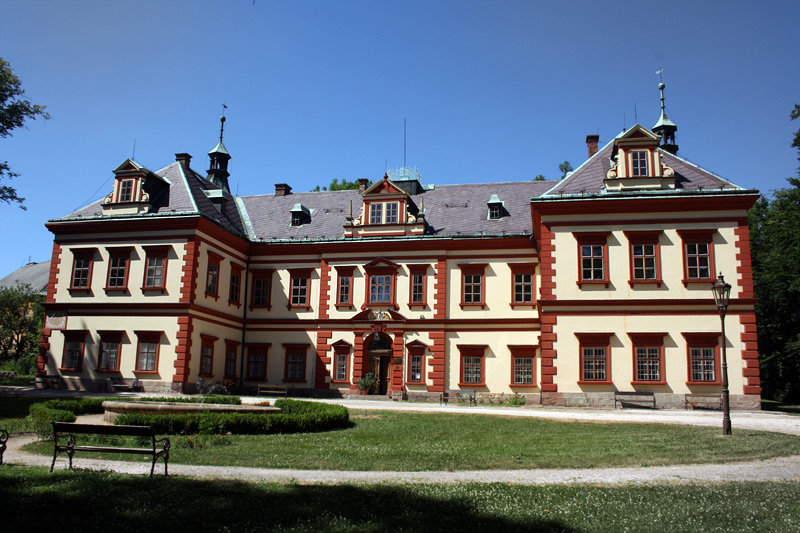
Museum of Giant Mountains in Jilemnice
The Krkonoše Museum was founded in 1891 in connection with the first preparations for the Czechoslovak Ethnographic Exhibition in Prague. The first exhibition was installed at the turn of the century in a former girls' school, later the museum moved several times, for a long time it used rooms on the ground floor of the old town hall, and since 1953 it has been housed in the former castle of the counts of Harrach. The decisive credit for building the museum belongs to the former director of girls' schools in Jilemnice Jáchy Metelek (1853 – 1940). Already in 1929, the germs of today's three exhibition blocks were created: historical-ethnographic, ski and gallery, but they could only be developed after moving to the chateau. Thus, the museum's collection program focuses mainly on the history and ethnography of the western Giant Mountains, the beginnings and development of Czech skiing, in the gallery area mainly on the work of František Kaván (1866 – 1941). Since 1979, the museum has been a facility Administration of the Krkonoše National Park.
Ski exhibition
"A white trail. Chapters from the history of Czech skiing until 1938 ”. The exhibition comprehensively describes the development of our skiing and is divided into individual chapters: the development of world skiing since the mid-19th century, the beginnings of winter tourism and recreation in the Giant Mountains, the introduction of skiing in Bohemia and the first ski organizations, the establishment of skiers' association, armaments and equipment, the 50 km race and the tragedy of Hanča and Vrbata in 1913, the boom in the interwar period.
Historical-ethnographic exhibition
It mainly follows the historical development of the western Giant Mountains from the beginning of the great colonization in the 13th century to our time. Jilemnice, founded at the beginning of the 14th century as the economic center of the extensive Štěpanice (later Jilemnice) estate, became their natural center. The flourishing of the local trade and crafts is evidenced by a very rich and comprehensive collection of exhibited objects. A unique place is occupied by a collection of 33 burial shields from the first half of the 19th century and a unique linen yarn from the turn of the 18th and 19th centuries – 296 m of hand-spun fiber weighs only one gram. From folk culture, let us mention the rich collection of folk furniture and especially the nativity scenes of the Krkonoše Mountains. The most prominent place belongs to the unique mechanical sounded nativity scene from the years 1883-1913, the work of the director of girls' schools Jáchym Metelka. 142 moving figures create 350 different, very natural movements and everything is driven by a single weight through a single machine. The remaining three weights are for sound effects only.
Castle exposition From the life of a Czech cavalier
It describes the life of the excellent nobleman Jan Nepomuk, Count Harrach (1828 – 1909). It includes a tour of the corridor, the castle dining room, the men's salon, the women's boudoir, the bedroom, the anteroom and the study.
Kaván's gallery
It was founded in 1956 on the occasion of its late 90th birthday František Kaván (1866-1941). The painter was born in Víchovská Lhota near Jilemnice and his native region remained permanently inscribed in his soul and work. In the years 1889-95 he studied at the Prague Academy of Painting with Julius Mařák. Under his leadership, he quickly grew into a prime landscape painter, and most of his works from that time belong today to the golden fund of Czech landscape painting. The famous Podmrak painted in Víchovská Lhota in 1894 was awarded a gold medal at the World Exhibition in Paris six years later. Kaván's gallery owns approximately 90 works by this leading Czech landscape painter.
Source and photo: www.kmjilemnice.cz